
Passio Montani et Lucii
The Passion of Lucius, Montanus, Flavianus and their companions
Identity & dating
- Principal titles
- Passio sanctorum Montani et Lucii; Actus et visio martyrum Luci Montani et ceterorum comitum. The Karlsruhe rubric names Montanus and “Gemellis”; the latter is an unresolved title problem, not a securely identified companion.
- Identifiers
- BHL 6009 · CPL 2051 · BiblIndex PAS.MON · Oxford E07938 / S02404.
- Language & genre
- Latin. A collective prison letter followed by an anonymous martyrdom narrative.
- Historical setting
- Valerian’s persecution, AD 259; probably Carthage. The main group’s commemoration is 23 May; Flavianus follows two days later. The medieval transmission also supplies 24 February and other dates.
- Date of composition
- A third-century core with editorial shaping. The date of the events, the composition of the prison letter and the formation of the transmitted text should not be treated as identical.
- Authorship
- The text associates Flavianus with the prison letter and commissions an anonymous continuator. Identification of the continuator with Pontius is not established.
- Structure
- 23 chapters in the dossier’s reference system: §§ 1–11, prison letter; §§ 12–23, continuation. Numbering and subdivisions are editorial conventions.
- Incipit
- Et nobis est apud uos certamen, dilectissimi fratres…
- Closing words
- …etiam de nouis aliqua discamus.
- Text in the reader
- Complete Latin text, §§ 1–23, from Dolbeau (1983), pp. 67–82. Digital apparatus: Dolbeau selected notes; Gebhardt’s complete printed page notes and relevant erratum available in its own reading layer. No complete witness transcription. See coverage and fragment inventory. The edition change is explicit: earlier edition used selected Musurillo passages. Scripture and literary references cite Dolbeau’s notes.
Sources: Dolbeau (1983), pp. 39–40, 53, 63–67, 82; Oxford, E07938.
Contents at a glance
| Sections | Narrative movement | Research questions |
|---|---|---|
| 1–2 | The prisoners explain why they write; arrests and deaths are recalled. | Communal memory; epistolary form; baptism and martyrdom. |
| 3–6 | Deliverance from fire, prison, Renus’s lamp vision and interrogation. | Danielic typology; spiritual light; victory language. |
| 7–11 | Visions, hunger, aid from fellow Christians and reconciliation. | Dream narrative; charity; unity; Cyprian’s authority. |
| 12–15 | Judgement, the main group’s execution and Montanus’s instructions. | The lapsi; ecclesial discipline; charismatic authority. |
| 16–20 | Flavianus returns to prison and is finally sentenced. | Maccabean motherhood; courage; provincial administration. |
| 21–23 | Flavianus’s visions, rain, execution and final directions. | Water and blood; succession; the usefulness of new exempla. |
Section map checked against the Latin text and Oxford E07938. The “Research questions” column is an Agios reading aid.
Place in the tradition
African martyr literature
The Passion belongs beside the narratives of Perpetua and Felicitas (BHL 6633) and Marianus and Iacobus (BHL 131). Cyprian supplies a major doctrinal and stylistic point of reference. Dreams, communal care and the authority of confessors connect the work to this African literary setting; shared motifs alone do not prove direct borrowing.
Scripture and communal norms
Biblical language makes contemporary suffering intelligible through earlier exempla. Prayer, reconciliation and constancy are also models for the reader’s conduct. The place of martyrs in church discipline makes the text particularly relevant to questions of authority and unity.
Two transmitted families
Dolbeau separates α (principally X and Y; 23 May) from β (usually 24 February, with internal branches). Family α has shorter disciplinary passages in §§ 14 and 23. His proposal that this reflects Catholic attenuation of material compatible with Donatist interests is an interpretive hypothesis. It must not be converted into a proven date or confessional identity for every witness.
Historical evidence
Dupuis examines the regionantes, interim provincial government and ducenarius. These readings affect historical interpretation. The identification of the anonymous procurator with a specific fiscal office is his argument, not a named official supplied by the narrative.
Sources: Dolbeau (1983), pp. 39–40, 61–65; Tilley (1990); Dupuis (2003), pp. 253–265.
Stemma codicum
After François Dolbeau (1983), p. 60. This is a digital redraw of the published relationships, not a new stemma computed by Agios. The printed chronological layout is replaced with a topological layout.
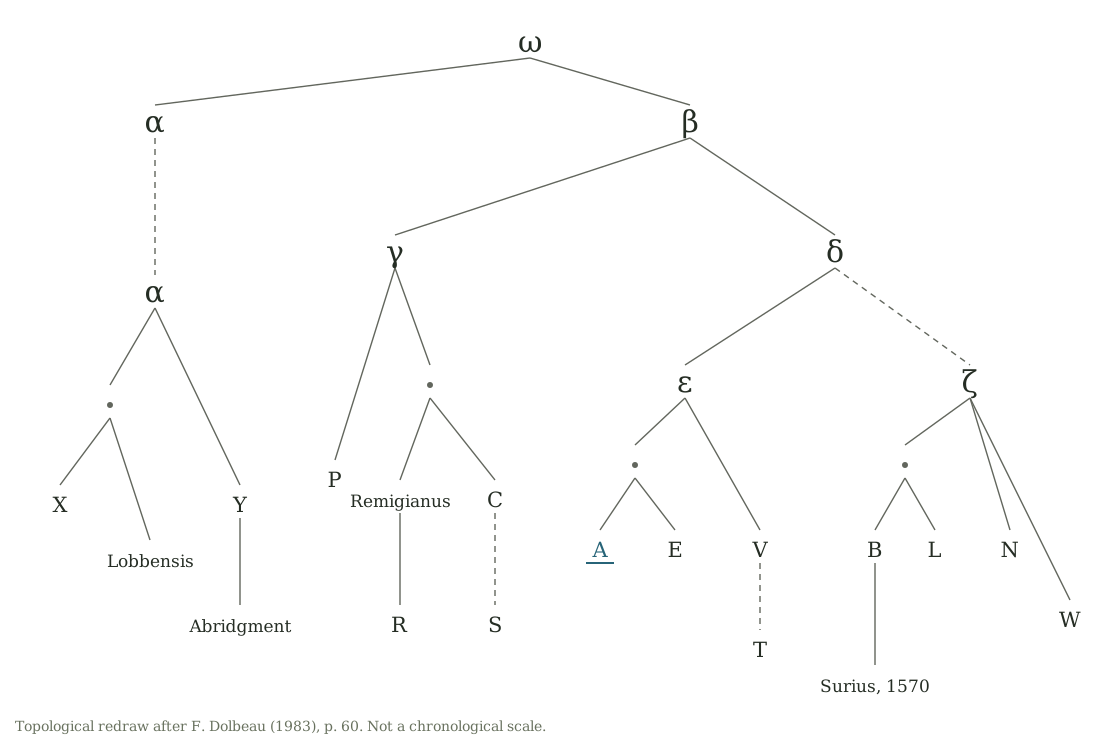
Greek letters denote reconstructed ancestors or groups. Small unlabelled junctions retain unnamed intermediaries. Dashed connections follow the dashed connections in Dolbeau’s figure; they do not mean “all links are equally certain”. Select a Latin siglum to jump to its witness record.
A is Karlsruhe, Aug. perg. 32, in ε. R is a 1689 collation of the lost Remigianus, not an extant medieval copy. Lobbensis denotes the lost Lobbes witness; Abridgment is a later textual derivative. The figure shows S downstream of C and T downstream of V with dashed links; consult pp. 57–59 for the qualifications.
Dolbeau notes contamination within ε (p. 59). The tree should therefore be read with his discussion, not as an exhaustive map of every act of correction. A follow-up review by Bouhot (1984), cited by Dupuis, remains to be checked before presenting an updated reconstruction.
Manuscripts & sigla
Thirteen surviving medieval witnesses in Dolbeau’s 1983 inventory, plus the early modern collation R. Shelfmarks, dates and loci below follow that edition; current shelfmark changes have not been comprehensively re-audited.
| Siglum | Witness | Date | Text locus | Branch |
|---|---|---|---|---|
| X | Bern, Burgerbibliothek, 111 | Late 12th c. | ff. 141–144v | α |
| Y | New Haven, Beinecke Library, Marston 267 | 13th c. | ff. 67r–73v | α |
| P | Paris, BnF, lat. 17626 | Late 10th c. | ff. 16–22v | β / γ |
| R | Collation of the lost Reims, Saint-Remi 457 | 1689 collation | Paris, BnF, lat. 11768, f. 324rv | β / γ |
| C | Charleville-Mézières, 213 | Early 13th c. | ff. 154–157 | β / γ |
| S | Charleville-Mézières, 200 | Mid-13th c. | ff. 78–81v | β / γ |
| A | Karlsruhe, Aug. perg. 32 | c. 840 | ff. 105r–108r | β / δ / ε |
| E | Einsiedeln, Stiftsbibliothek, 247 | 12th c. | pp. 52–69 | β / δ / ε |
| V | Trier, Stadtbibliothek, 1152/776 (971) | 12th c. | ff. 268–272 | β / δ / ε |
| T | Trier, Stadtbibliothek, 1151, vol. 1/453 (962) | First half of 13th c. | ff. 40v–43v | β / δ / ε |
| B | Brussels, KBR, 207–208 (VDG 3132) | First half of 13th c. | ff. 123v–126 | β / δ / ζ |
| L | London, British Library, Harley 2800 | Early 13th c. | ff. 238v–240v | β / δ / ζ |
| N | Paris, BnF, lat. 5289 | 14th c. | ff. 22–26 | β / δ / ζ |
| W | Berlin, Theol. lat. qu. 141 | c. 1450–1460 | ff. 178v–182 | β / δ / ζ |
No matching witness.
Lost witnesses and the later abridgment
The 1983 inventory also records Igny, codex 7; Lobbes, codices C and G; Reims, Saint-Remi 457; and Val-Secret, codex 6. The separate short abridgment is represented by four late copies. These are not additional independent medieval witnesses to be counted alongside the thirteen surviving copies.
Only the relationships actually shown in Dolbeau’s figure are plotted above. The lost Lobbes codex C must not be confused with the siglum C for Charleville 213.
Source: Dolbeau (1983), pp. 40–47, 60, 66. Download witness data (JSON).
Notes on the critical text
The following are editorial notes for consulting the editions. They are not a fresh collation of the digitized manuscript.
3.2 · solus / solet
Dolbeau adopts solet from XY. A supplies solus with an infinitive and no finite verb in the relative clause. Other witnesses repair the difficulty in different ways. The complete Agios reader now follows Dolbeau with solet … liberare. Musurillo’s solus … potest liberare is a different editorial text.
Dolbeau, pp. 53–54 and 68; Musurillo, p. 214. Read § 3.2 · Inspect 105r.
12.4 · religio sapientiae / religiosa patientia
The reading of XY, religiosa patientia, offers a different division and interpretation of the wording transmitted elsewhere as religio sapientiae. Dolbeau brings lexical parallels and prose rhythm into his decision.
Dolbeau, p. 54; edition p. 75.
19.4 · pro amicitiae iure
Family α supports pro amicitiae iure. The transmitted alternatives in β underlie older editorial solutions. This example shows why the α witnesses cannot be omitted simply because they are later than A.
Dolbeau, p. 56; edition p. 79.
14 and 23 · The disciplinary omissions
Differences concern the lapsi, ecclesial peace and Lucianus’s designation for ecclesiastical office. Compare the actual α / β wording before drawing conclusions about recension, confession or the relative age of the branches.
Dolbeau, pp. 63–65.
How to use Dolbeau’s apparatus
Regular witnesses: XY, PRC and AEV. S, T and the ζ witnesses are cited selectively. Absence from an apparatus entry therefore does not establish agreement unless the edition’s conventions permit that inference. R is known through a partial collation; unavailable testimony is not a manuscript lacuna.
Editorial sigla include Fr (1898), Fra (1909), Ge, La, Mu and Wil. Preserve the distinction between manuscripts, conjectures and editorial decisions. The edition is eclectic: A is important but is not its sole basis.
Dolbeau, pp. 59–61, 66.
Editorial history
| Year | Milestone | Use in Agios |
|---|---|---|
| 1570 | Surius, first printed edition; linked to B in Dolbeau’s reconstruction. | Editorial history; not the reader’s base. |
| 1898 | Franchi de’ Cavalieri’s critical edition. | Compare with his subsequent corrections. |
| 1902 | Gebhardt’s anthology and internal subdivisions. | Reference conventions and conjectures. |
| 1909 | Franchi de’ Cavalieri reconsiders the text using A. | Essential corrections to the 1898 edition. |
| 1956 | Lazzati’s anthology. | Intermediate editorial synthesis. |
| 1972 | Musurillo’s Latin text with English translation. | Comparison edition with English translation; the earlier excerpt source. |
| 1983 | Dolbeau’s expanded tradition, stemma and edition. | Base of the complete reader, checked references, dossier and stemma. |
Source: Dolbeau (1983), pp. 47–52, 60, 66. Distinguish an edition’s publication date from the date of its underlying manuscripts.
Bibliography
Dolbeau, F. (1983). “La Passion des saints Lucius et Montanus. Histoire et édition du texte.” Revue des études augustiniennes 29, 39–82.
Principal source for the dossier: witnesses, pp. 40–47; editorial history, pp. 47–52; relationships and stemma, pp. 52–61 (figure p. 60); historical reconstruction, pp. 61–65; sigla, p. 66; Latin edition, pp. 67–82.
Open publication / DOI ↗Musurillo, H. (1972). The Acts of the Christian Martyrs. Oxford: Clarendon Press, 214–239.
Latin text and English translation. Source of the earlier Agios excerpts; predates Dolbeau’s expanded manuscript investigation.
Open publication / DOI ↗Franchi de’ Cavalieri, P. (1898). Gli atti dei SS. Montano, Lucio e compagni. Römische Quartalschrift, 8. Supplementheft. Rome; Latin edition, 71–86.
Early modern scholarly edition. Bibliographical details and its place in editorial history are documented by Dolbeau, pp. 50–51, 66.
Verify reference in cited study ↗Gebhardt, O. von (1902). Ausgewählte Märtyreracten und andere Urkunden aus der Verfolgungszeit der christlichen Kirche. Berlin, 146–161.
Revises the 1898 text and introduces internal subdivisions. Reference checked against Dolbeau, pp. 51, 66.
Verify reference in cited study ↗Lazzati, G. (1956). Gli sviluppi della letteratura sui martiri nei primi quattro secoli. Turin, 202–213.
An anthology incorporating Franchi de’ Cavalieri’s subsequent corrections. Reference checked against Dolbeau, pp. 51–52, 66.
Verify reference in cited study ↗Franchi de’ Cavalieri, P. (1909). “Nuove osservazioni critiche ed esegetiche sul testo della Passio sanctorum Montani et Lucii.” Note agiografiche, fasc. 3, Studi e Testi 22. Rome, 3–31.
Critical reconsideration after the Karlsruhe witness became available. The collation of A is discussed by Dolbeau on p. 51.
Verify reference in cited study ↗Bouhot, J.-P. (1984). Review of Dolbeau’s edition. Revue des études augustiniennes 30, 363–364.
A follow-up on the manuscript tradition, cited by Dupuis (2003), p. 253 n. 3. The review itself has not been inspected for this dossier; no changes to the 1983 stemma are inferred from it.
Verify reference in cited study ↗Dupuis, X. (2003). “Hagiographie antique et histoire : l’exemple de la Passion de Lucius et de Montanus.” Revue des Études Augustiniennes 49, 253–265.
Historical interpretation: municipal policing, urban regiones, the procurator acting for a deceased proconsul, and the designation ducenarius.
Open publication / DOI ↗Monceaux, P. (1902). Histoire littéraire de l’Afrique chrétienne depuis les origines jusqu’à l’invasion arabe. Vol. 2. Paris, 165–178.
Classic discussion of the Passion, cited at the beginning of Dolbeau’s study.
Verify reference in cited study ↗Tilley, M. A. (1990). “Scripture as an Element of Social Control: Two Martyr Stories of Christian North Africa.” Harvard Theological Review 83.4, 383–397.
Scriptural language, communal norms and the authority of martyrs.
Open publication / DOI ↗Lomanto, V. (1975). “Rapporti fra la ‘Passio Perpetuae’ e ‘Passiones’ africane.” In Forma futuri: Studi in onore del Cardinale Michele Pellegrino. Turin, 566–586.
Literary relationships with Perpetua; reference checked against Dolbeau, p. 40 n. 7.
Verify reference in cited study ↗Lucca, C. (2007). “Tratti profetici dei martiri nella Passio Mariani et Iacobi e nella Passio Montani et Lucii.” In A. D’Anna and C. Zamagni, eds., Cristianesimi nell’antichità. Spudasmata 117. Hildesheim, 149–173.
Prophetic features of African martyr narratives; bibliographical reference supplied by the Oxford record.
Verify bibliographical reference ↗Mertens, C. (1986). “Les premiers martyrs et leurs rêves : Cohésion de l’histoire des rêves dans quelques Passions latines d’Afrique du Nord.” Revue d’histoire ecclésiastique 81, 5–46.
Dreams and narrative cohesion; bibliographical reference supplied by the Oxford record.
Verify bibliographical reference ↗Meslin, M. (1972). “Vases sacrés et boissons d’éternité dans les visions des martyrs africains.” In Epektasis: Mélanges patristiques offerts au Cardinal Jean Daniélou. Paris, 139–153.
Visionary vessels and drinks; bibliographical reference supplied by the Oxford record.
Verify bibliographical reference ↗
A selected research bibliography, not an exhaustive census. Notes distinguish publications consulted from references verified through an edition or catalogue.
Research notes
Keep observations on dating, a witness or an editorial decision. These notes are saved only in this browser and do not alter the scholarly dossier.